
We've All Agreed To Pretend This Is Fine
On saddle fit, sheepskin pads, and the gap between them
You get your horse's teeth done. You schedule the chiropractor, the massage therapist, the farrier every six weeks without thinking about it. You did a full round of injections last spring. You send your LL Bean duck boots in to be re-soled rather than replace them because they fit and you love them.
When did a professional saddler last look at your saddle on your horse?
Not glance at it. Not eyeball it from the fence. Actually look at it. The panel contact, the balance, the fit through the shoulder, what it's doing to your position.
For most riders the answer is never. Or once, years ago, when the horse was younger and the saddle was newer and neither of them are exactly the same anymore.
This isn't a character flaw. It's an infrastructure problem.
There are roughly 300 brands of saddles, and counting. The pool of people qualified to assess fit across all of them. Understanding not just the saddle but the anatomy underneath it and the rider on top of it, is small. Genuinely small. Black sheep saddlery is one of the great ones. She’s in my area (SW GA) occasionally but is based in Virginia. Most of them are concentrated in Virginia and the Mid-Atlantic. The rest are stretched thin across the country, overwhelmed, and booked out.
Your trainer has an eye. Probably. Hopefully. But asking your trainer to assess saddle fit is like asking your brother-in-law to look at your engine. He drives every day. He means well. He is not a mechanic. And he might have a sponsorship deal.
Most upper-level trainers are closer to the rally car driver. Talented enough to go around in anything, on horses with expensive enough bloodlines that equipment fit is a secondary conversation. They genuinely cannot feel what you're feeling in your Ford on your Tuesday horse. That's not a knock. It's just a different problem set.
So we all adapted. We learned to shim. We asked the brand rep. We called whoever was available, credentials optional. We googled. We do our best because our best is the only option on the table.
And the horses went around. And we tell ourselves it’s probably fine.
Sometimes it is fine. Sometimes it isn't. And sometimes it causes vet bills that cost more than three saddles ever thought about. The difference between those three things is not always obvious from the saddle.
Mattes Half Pads: A Practical Fix While You Wait
You use what's available. And what's available, if you choose correctly, is actually pretty good.
A quality half pad with a correction system is not a luxury purchase. It's a practical response to a real problem. The shim pockets in a Mattes pad allow you to address panel imbalance, bridging, and minor fit issues. Not perfectly, not permanently, but well enough to matter. It buys your horse comfort and your saddle time while you wait for the real fix from a real saddler.
It is not a substitute for a saddler. Nothing is. But it's a competent bridge and that's exactly what most of us need most of the time.
A few things worth knowing before you buy one.
How to Use a Sheepskin Half Pad Correctly
I say this with love, and because literally every picture you've ever seen shows people using them the way I'm sure you do. The instinct is to layer horse, cotton pad, sheepskin half pad, saddle. It feels logical. The sheepskin is the expensive part and you want to protect it.
The correct order is horse, sheepskin against skin, cotton pad on top, saddle. The sheepskin needs to be what touches your horse to do its job. The airflow, the wicking, the cushion and the weight distribution all happen at that contact point. Put cotton between the sheepskin and the horse and you've bought a very expensive pillow that isn't doing much else.
You paid for three things: wicking, airflow, and even pressure distribution. If the sheepskin isn't against your horse, you're only getting one of them. That's it. A third of what you actually paid for, on every single ride.
The PM System
Place the half pad against the horse, then thread the cotton pad's buttonhole over the velcro. Everything stays put. The cotton takes the sweat, the friction, the daily abuse. The sheepskin does its job.
This is a Mattes thing. Nobody else does it. They use it on their exercise sheets too, to keep them from shifting. The cotton pads are comparable in price and quality to an Ogilvy. Plan for shipping time from Poland.
What the system actually gives you: swap cotton pad colors between rides, between classes, between moods, without touching the half pad underneath. The sheepskin stays put. The cotton handles the dirty work and the aesthetic opinions.
Sheepskin Half Pad Care: What Works
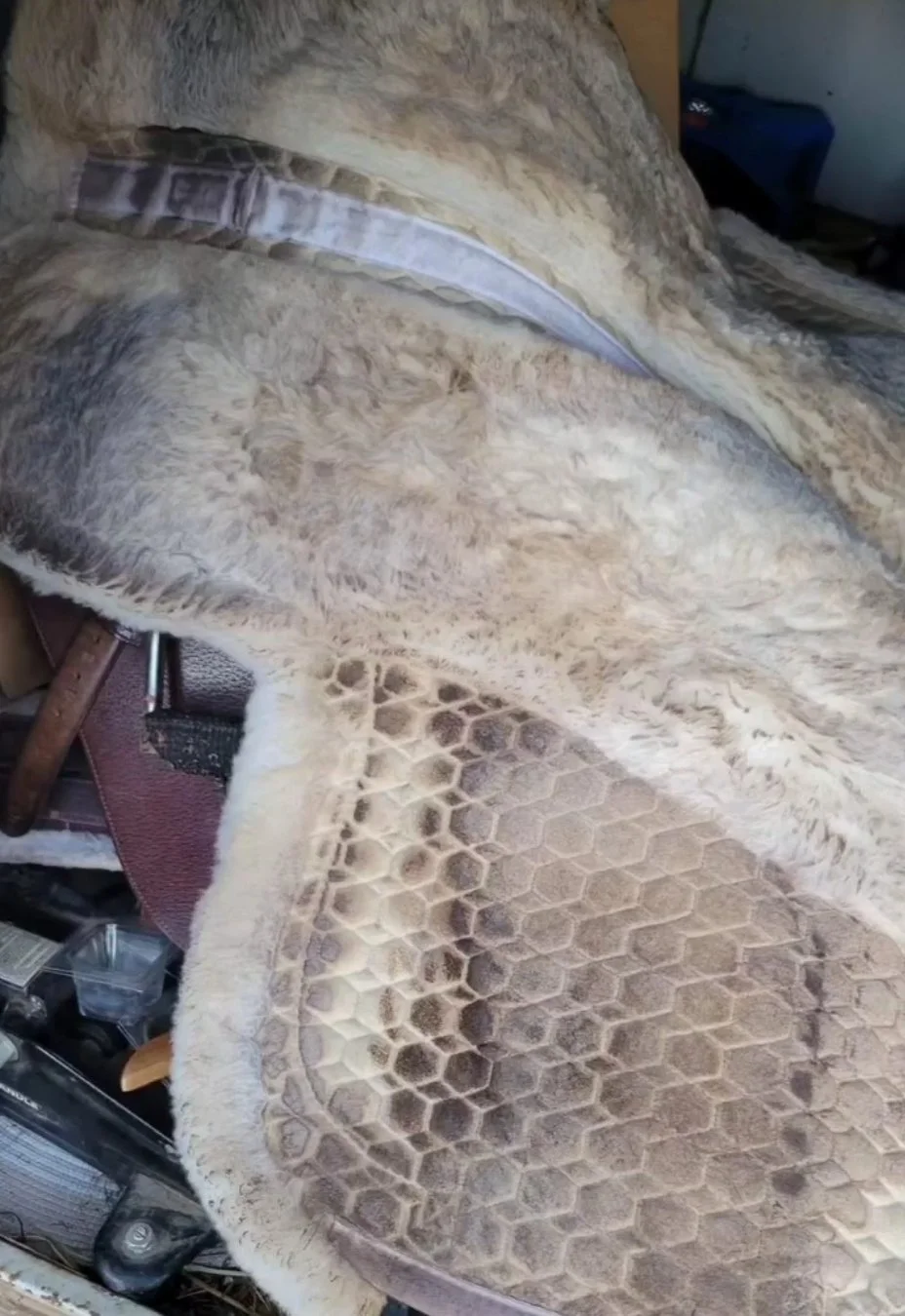
Disgusting Sheepskin Saddle Pad after a day of Fox Hunting in South Georgia.
Sheepskin pads last. They last remarkably well and they are made to be used and washed.
After each ride: pull the pad, flip it sheepskin-side up, put it somewhere with airflow. Do not touch it while it's wet. Do not brush it wet. Let it dry completely.
Before your next ride: stiff brush, fluff it back up, ride.
When brushing stops cutting it — and eventually it won't, because your horse absolutely rolled in something before you got him out — wash it. Mattes Melp, warm water. The literature says 30 degrees Celsius, so check your machine's temperature readout if you're unsure where yours lands. Don't be afraid of the wash. [TikTok link: here's what it looks like coming off a hunt.] This is not a decorative object. It's a piece of equipment and it performs like one when you treat it like one.
Horses are disgusting. Wash the pad. It will be better off for it.
Ideally you have two. Not because the pad is fragile but because it needs to dry completely between rides, and if you're riding twice a day that math doesn't work with one pad. Same reason you rotate your good boots. Natural materials need to recover between sessions to perform their best and last.
You paid for airflow, wicking, a correction system, and even pressure distribution. You only get all of that if the sheepskin is against your horse, dry before you ride, and maintained between uses.
Your horse went around today. Was it probably fine?
Maybe.